If you have ever asked a designer whether they do UX design or service design and received a long, uncertain pause in response, you are not alone. The two disciplines overlap significantly, share many tools, and are often practised by the same people. But they are not the same thing.
What UX design focuses on
UX design is primarily concerned with the experience of using a specific product or interface. A website, an app, a dashboard. The UX designer's job is to make that product clear, usable, and useful — to reduce friction and increase the likelihood that a user achieves their goal.
The scope is bounded by the product. What happens before a user arrives and what happens after they leave is generally outside the frame.
What service design focuses on
Service design takes a wider view. It is concerned with the entire ecosystem around a service — every touchpoint, every channel, and the internal operations that make those touchpoints possible.
A service designer looking at a bank is not just looking at the mobile app. They are looking at the branch experience, the call centre, the onboarding letter, the statement format, the complaints process, and how all of those things connect. They are also looking at the backstage: the staff workflows, the data flows, the systems that front-of-house experiences depend on.
Where the confusion comes from
The confusion is understandable because good UX design often requires thinking about the service context, and good service design always involves thinking about user experience. The tools overlap too — both disciplines use journey mapping, research, prototyping, and testing.
The clearest distinguishing factor is scope. UX design optimises an interaction. Service design redesigns a system.
When do you need each?
You need UX design when the problem is: our product is hard to use, our conversion is low, users are dropping off at a specific point, or our interface feels dated and confusing.
You need service design when the problem is: customers are having a bad experience but we cannot pinpoint why, our digital and physical channels feel disconnected, our internal processes are creating customer-facing failures, or we are launching a new service and need to design it holistically.
And when do you need both?
Most of the time. A great digital product with a terrible customer service experience will still disappoint. A seamless service ecosystem built on a confusing interface will still frustrate. The best outcomes come from teams that think at both scales simultaneously.
UX design focuses on optimizing the usability and clarity of a specific product or interface (like a website or app), with a scope largely bounded to what happens while the user is interacting with that product. Service design takes a broader, systemic view of the entire service ecosystem across all touchpoints and channels, including the backstage operations, processes, and systems that enable the front-stage experience.
The main difference is scope:
- UX design optimizes an interaction: making a given interface more usable, useful, and effective.
- Service design redesigns a system: aligning all touchpoints (digital, physical, human) and the underlying operations to create a coherent, end-to-end experience.
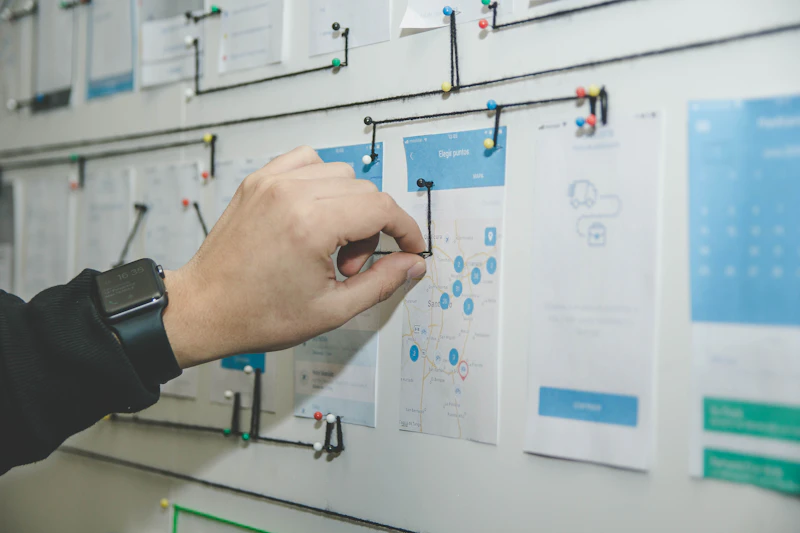
The service blueprint is the key tool that distinguishes service design from UX practice. Unlike a journey map that focuses on what the user experiences, a service blueprint adds layers for:
- Front-stage actions (what customers and frontline staff do)
- Backstage processes and workflows
- Supporting systems, data flows, and policies
This often reveals that many customer experience problems originate in backstage issues (disconnected processes, poor handoffs, rigid policies, or incompatible systems) that cannot be solved by interface design alone.
You typically need UX design when the issue is clearly product-specific (e.g., low conversion on a page, drop-off at a particular step, confusing UI). You need service design when the issue is systemic (e.g., inconsistent experiences across channels, unclear ownership, operational failures surfacing as customer pain, or designing a new service from scratch).
In practice, most organizations need both: strong UX to make individual touchpoints work well, and strong service design to ensure those touchpoints fit into a coherent, reliable end-to-end experience. The critical skill is diagnosing the problem at the right altitude—knowing whether you are dealing with an interaction-level issue (UX) or a system-level issue (service design), and then applying the appropriate tools.
UX design focuses on improving the usability, clarity, and effectiveness of a specific product or interface (like a website or app) during the time a user is actively interacting with it. Service design takes a broader, systemic view of the entire service ecosystem across all touchpoints and channels, including the backstage operations, processes, and systems that enable the front-stage experience.
The key difference is scope:
- UX design optimises an interaction: it tackles problems like low conversion on a page, confusing flows, or outdated UI.
- Service design redesigns a system: it addresses issues like inconsistent experiences across channels, operational failures that surface as customer pain, or the need to design a new service end-to-end.
A service blueprint is the signature tool of service design. It extends beyond a user journey map by explicitly mapping:
- Customer actions and front-stage staff actions
- Backstage processes and workflows
- Supporting systems, data flows, and policies
This makes it clear when customer problems are actually rooted in backstage issues that UX changes alone cannot fix.
In practice, organisations usually need both:
- UX design to make individual touchpoints (screens, flows, interfaces) work well.
- Service design to ensure all those touchpoints and the underlying operations form a coherent, reliable, end-to-end experience.
The crucial skill is diagnosing the problem at the right level: is it an interaction-level issue (UX) or a system-level issue (service design)?